

 Why Partners Are Choosing One CX Partner, Not Three">
Ask a reseller how many vendors sit behind their contact centre proposition and the honest answer is rarely one. A CCaaS platform from one vendor. A conversation analytics tool from another. An AI agent or chatbot from a third, bolted on because a client asked for it and nobody wanted to say no. Each with its own onboarding process, its own support line, its own account manager who doesn't know what the other two are doing, and its own renewal date landing at a different time of year.
Individually, each of those deals probably made sense. Together, they add up to a quiet but real tax on the partner: more relationships to manage, more inconsistent messaging when you're in front of a client, and more risk that one vendor's roadmap or pricing change disrupts a proposition you've spent years building. That's the gap a genuinely multi-product, platform-agnostic partner closes, and it's worth understanding why that matters more now than it did a few years ago.
The Real Cost of Vendor Sprawl (Even When Every Vendor Is Good)
None of this is about any single vendor being bad at their job. It's about what happens when a partner's proposition is stitched together from three or four separately-run relationships instead of one coherent one.
Every additional vendor means another onboarding process to learn, another support escalation path to remember, another set of collateral to keep track of, and another account manager relationship to maintain, each with their own priorities, which may or may not include yours. When something goes wrong for a client who's using two of your three vendors' products together, working out whose issue it actually is can eat hours you don't bill for. And when you're pitching a client on a joined-up "AI-enabled CX" story, three different vendor logos on the same slide undermines the story you're trying to tell, even if every individual product is excellent.
Why "One Partner, Multiple Platforms" Is a Genuinely Different Model
The alternative isn't picking one vendor and hoping they eventually build everything you need. It's finding a partner whose portfolio was designed from the outset to work together, and critically, to work with whatever a client already has instead of only with each other.
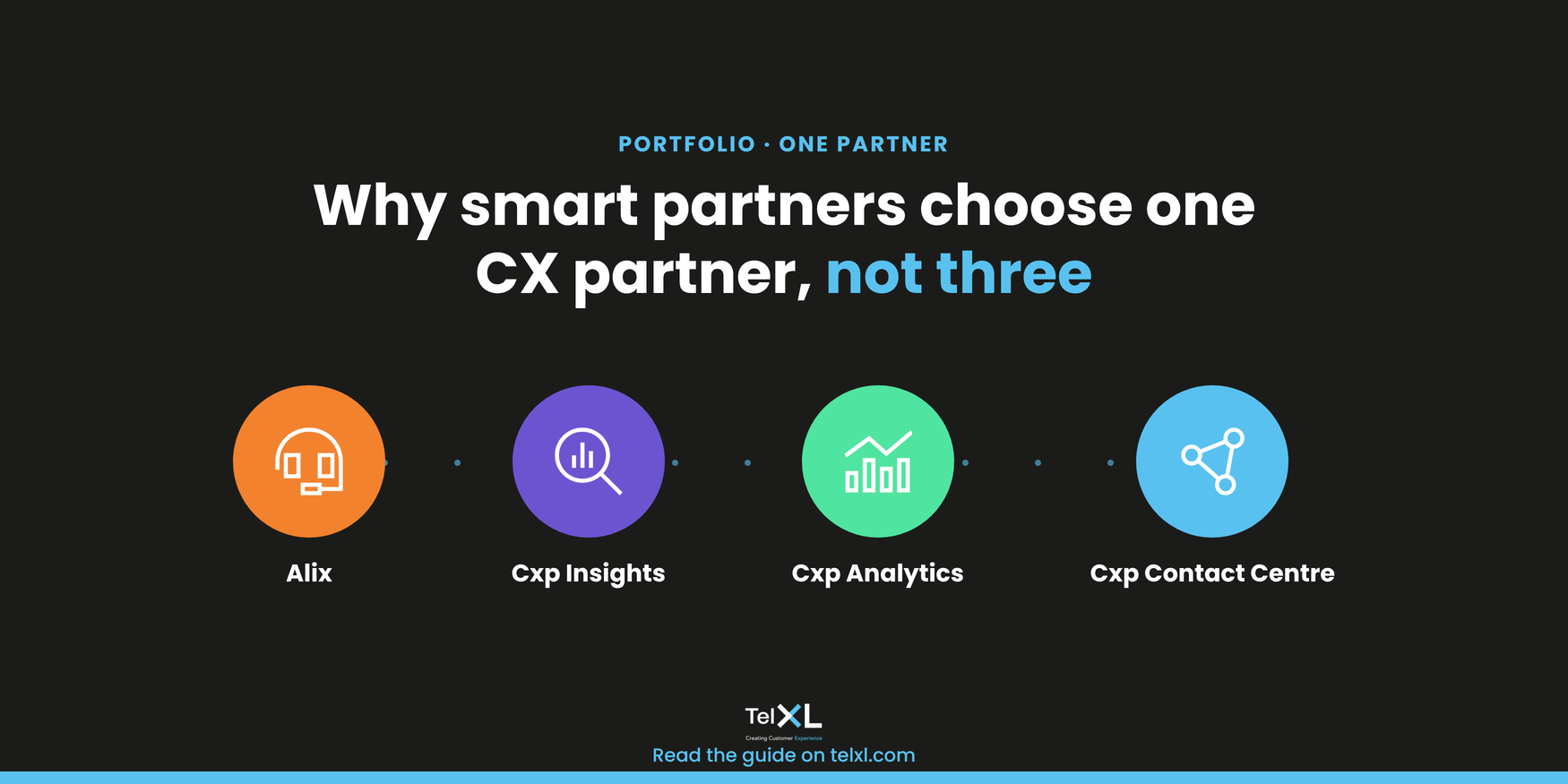
That's the model behind TelXL's own portfolio: one suite, four ways to add value. Cxp is the core omnichannel CCaaS platform for partners building or replacing a client's contact centre from the ground up. Cxp Insights is a focused, one-off assessment that turns a client's existing conversations into a clear picture of where automation and improvement opportunities sit. It's often the easiest way to open a strategic conversation with a client who isn't ready for a bigger change yet. Cxp Analytics takes that same conversation intelligence and runs it continuously, turning it into an ongoing service. Alix adds a genuinely conversational AI agent that can answer calls, book appointments, and handle first-line enquiries end to end.
The part that actually matters for a partner juggling vendors: Cxp Insights, Cxp Analytics, and Alix are all platform-agnostic. None of them require a client to rip out their existing CCaaS platform first. A partner can bring AI-powered insight or a virtual agent to a client running on a completely different CCaaS platform, with no migration and no disruption to live operations, and still offer the full Cxp platform to clients who are ready for a genuine consolidation. That combination, one vendor covering both "add AI value to what a client already has" and "replace what a client already has," is what a stitched-together multi-vendor stack structurally can't offer.
One Relationship, One Story, One Escalation Path
The practical upside for a partner shows up in the day-to-day, well beyond the pitch deck. There's one account manager who understands the client's full footprint across CCaaS, analytics, and AI, instead of three who each only see their own slice, and one support relationship to escalate through when something crosses product boundaries. There's also one consistent brand story to tell a client, rather than stitching together messaging from three different vendors' marketing decks and hoping it reads as coherent.
It also changes the shape of the sales conversation itself. Instead of a partner having to decide up front which single vendor to recommend and then living with that choice, a portfolio approach lets the conversation start wherever the client actually is: a focused analytics assessment for a client who's curious but not ready to commit; a virtual agent for a client with an obvious call-handling gap; or a full platform migration for a client whose current CCaaS setup is genuinely holding them back. All of it runs through the same relationship, building toward the same account instead of three separate, disconnected deals.
A Natural Path to Deeper Accounts
This matters commercially too, beyond simplifying day-to-day admin. A client who starts with a single, focused engagement (an analytics assessment, say) and sees real value from it is a far easier conversation to expand than a cold pitch for a full platform replacement. Because the next product in the portfolio is built by the same partner relationship, on the same underlying philosophy, that expansion conversation is a natural next step rather than a fresh sales cycle with a vendor the client has no relationship with yet. Partners running a single-vendor point solution don't have that same expansion path available to them; there's nowhere for the relationship to go once the original deal is signed.
The Takeaway
Vendor sprawl rarely looks like a mistake in the moment; each individual product decision usually makes sense on its own. It's the accumulated overhead of managing several disconnected vendor relationships that quietly erodes a partner's margin and their client's confidence in a joined-up story. A single partner covering the full range, from a focused one-off assessment through to a full CCaaS platform, without forcing a client to rip out what they already have, isn't just administratively simpler. It's a genuinely different, stronger proposition to put in front of a client, and a natural path to a deeper, more durable account over time.