
 AI Readiness for Contact Centres: Why a Checklist Isn't Enough">
Ask most contact centre leaders whether they're "AI ready" and they'll point to a checklist somewhere: cloud infrastructure ticked off, data governance signed off, a vendor capability matrix filled in. Boxes checked, budget approved, project green-lit.
Then the pilot launches, and it stalls. Not because the infrastructure was wrong. Because nobody actually looked at what was being said on the calls before deciding what to automate. This is the quiet gap behind a lot of stalled AI projects: readiness assessments that score the environment around the conversations, without ever analysing the conversations themselves.
What Most "AI Readiness" Actually Measures
The AI readiness assessments most contact centres encounter fall. Cloud-vendor frameworks check infrastructure, data pipelines, and governance. That's useful, but it's scoped to whether your systems can technically support AI, not whether your call volume contains anything worth automating. Generic consultancy checklists assess vendor capability, integration depth, and organisational change-readiness, all of it upstream of the actual question: which conversations, specifically, are good automation candidates, and which aren't?
None of this is wrong. It's just answering a different question than the one that actually determines whether an AI investment pays off. A contact centre can be technically ready, organisationally aligned, and still automate the wrong things, because nobody scored the calls themselves for automation potential, complexity, or deflection likelihood before committing.
That's the gap between what AI vendors claim in a pitch deck and what shows up in production: real productivity gains exist, but they're specific and unevenly distributed across call types. You don't get them simply by buying a platform and pointing it at your queues.
Assessing the Conversations, Not Just the Environment
A genuinely evidence-based assessment starts somewhere different, it starts with the calls themselves. That means taking a real, representative slice of recent customer conversations and analysing them directly, rather than inferring readiness from a survey or a systems diagram.
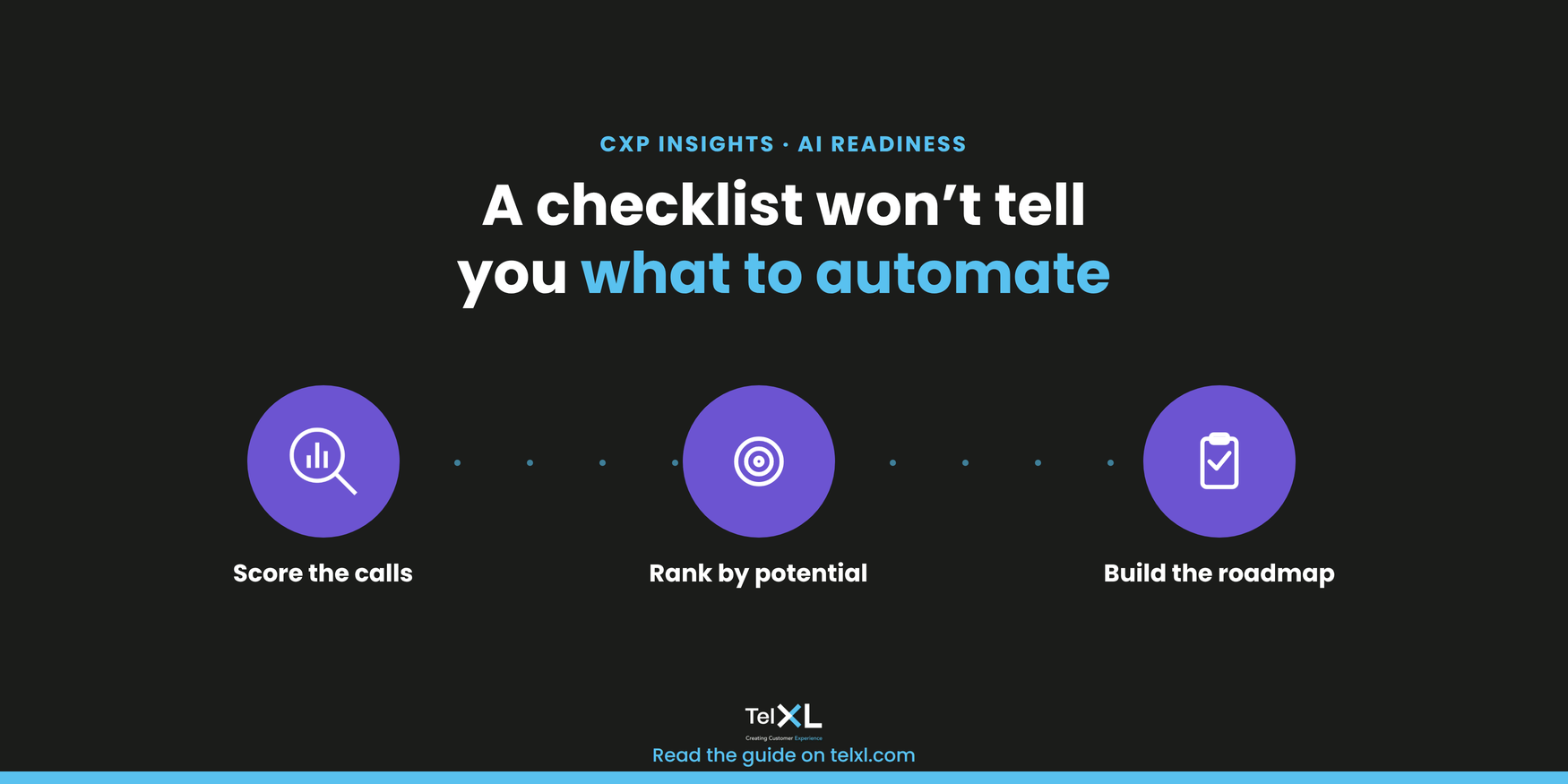
Done properly, that analysis covers several layers at once. Category and topic identification tell you what people are actually calling about, not what the call-reason drop-down assumes. Complexity and automation-potential scoring per call type turns "automate customer service" into a ranked list of specific call types with a realistic deflection percentage attached to each, instead of one yes/no verdict on the whole operation. CSAT and issue-resolution metrics get layered against those categories, so a call type doesn't get flagged as automation-ready just because it's short; it has to also resolve well. And quality and compliance monitoring runs across the same sample, because a call type riddled with regulatory risk is a poor automation candidate regardless of how routine it looks on paper.
Getting transcription right matters more than it sounds like it should. Telephone audio is noisy, accented, cross-talking, and full of hold music, and a transcription layer optimised specifically for that environment produces meaningfully cleaner category and sentiment data than general-purpose speech-to-text bolted on as an afterthought.
Why "Most AI Pilots Underdeliver" Usually Traces Back Here
The pattern behind a lot of underwhelming AI pilots isn't a bad platform choice. It's a platform pointed at the wrong slice of volume, because nobody had the evidence to know better. A call type gets automated because it looks simple on a flowchart, and it turns out to carry hidden complexity, or a compliance sensitivity, or a resolution rate that was already poor before automation touched it. The project doesn't fail on technology. It fails on targeting.
This is also why checklist-based readiness scoring and evidence-based conversation analysis aren't competing approaches; they're answering different halves of the same problem. Infrastructure and governance checklists tell you whether you *can* deploy AI safely. Conversation-level analysis tells you *where* it will actually work. Skipping the second half and treating the first as sufficient is exactly the shortcut that turns "AI ready" into "AI deployed against the wrong calls."
From Assessment to a Roadmap You Can Actually Act On
The output of a proper assessment isn't a readiness score out of ten. It's a prioritised implementation roadmap: the call types and processes worth automating first, sequenced against ones better suited to a medium-term phase, or not suited to automation at all. Alongside that: interactive dashboards showing the category, resolution, and quality patterns the roadmap is based on, plus a guided review session to walk through what the data actually shows before any automation decision gets made.
That combination, a specific, evidenced roadmap instead of a generic maturity score, is what separates an assessment that changes what gets built from one that just gets filed after the workshop.
A Low-Risk Way to Answer the Question Properly
For a lot of operations teams, the honest barrier to this kind of assessment isn't scepticism about the value, it's that getting there normally means someone manually listening to a meaningful sample of calls, which very few teams have the headcount to do at any real scale. Cxp Insights exists specifically to close that gap, it is a structured, one-off assessment that scores conversations for automation potential, resolution quality, and compliance risk, and hands back a roadmap built on the data rather than a generic industry benchmark.
It's designed as a low-risk starting point, deliberately, so you get a genuine, evidenced answer to "what should we actually automate" before committing to a larger AI or analytics programme, without finding out the hard way that the pilot was pointed at the wrong calls.
Would you like to know more about Cxp Insights, and how it can help your customers? Contact us below.
Would you like to know more about Cxp Insights, and how it can help your customers? Contact us below.